Monday, 27 September 2010


The last two Fridays I have been out and about - my ‘work diary’ will say community relations but I have been getting to know Tanzania!


On September 17th I went to the Graduation Ceremony for the Standard VII class at New Vision English Medium School (EMS).  This is a private school in a village 2 hours drive SW of Bukoba via 10 km of tarmac then 30 km of rough dirt road.  An EMS is a school where the medium of instruction is English.  The school is quite new.  This was their first ever graduating class and it had 11 students.  All of them will pass the Standard VII exam, the results won’t come until December but there is little doubt of their success. 
Steve and I were among the guests of honour at the ceremony.  When we’d agreed to go we had explained that we would need to leave at 12 noon as Steve had an appointment in town at 3 pm.  As the ceremony was due to start at 10 am this seemed reasonable but in the event it didn’t start until 11:30 so our departure ½  an hour later was a bit embarrassing!  We were there long enough to see some children dancing and singing and to speak to each of the students in the Graduating class.


This picture shows the Graduating Class singing a song about the importance of education.  Each of the girls sang a verse and everyone joined in with the chorus.  The boy on the end reminded me of Toby at the same age – gangly and uncoordinated with no sense of rhythm.  We enjoyed what we saw of the ceremony and were sorry to have to leave early.


Last Friday I attended a celebration of Adult Education at a government school not far from New Vision.  Steve was again busy so I went in the District’s 4WD driven by one of the District’s drivers.  There were little stalls set up showing the items of food, clothing and furniture produced by the adult education vocational classes and also agricultural exhibits from the agriculture class.  Again there were speeches, and singing and dancing by local school children, but also some traditional dancing by an adult group brought in for the day.  One of the speeches explained how important these classes were to the mostly young adults who accessed them – these students had for various reasons missed the chance to get an education as children and were making up the deficiency now.  Often they had missed out because of poverty and lack of parent support for education  The speech was delivered in the ‘sing-song’ of an Islamic Mosque service. 
One of the songs from a primary school group was about the importance of education but also included a plea for a more relevant curriculum (I applauded this verse loudly) and stronger support by elected officials for education. There was a rather long speech delivered by a region education leader and several shorter speeches translated for me by Mr Josiah.  A very nice lunch followed, cooked by the Home Economics class, and we returned to Bukoba about 5 pm.  Again it was a lovely day out and interesting to meet and chat to a variety of people.  I was the only Mzungu so received a special welcome in the speeches which is always embarrassing.


On the Monday in between these two events I had a trip to the Tanzanian Revenue Authority to fetch the umbrella I’d left there earlier the previous week.  I was on my own and the official who had helped us then (and who had the umbrella) was in the mood for a chat.  Where was the man I had had with me last time?  At home.  And who was he anyway?  My husband.  Was I happily married and did I love him?  Yes and yes.  How many children did I have? Three.  Only three?  Yes, that’s plenty to educate. (Here is where the conversation became relevant.)  The leader of the Inquisition, really a very nice man with the Tanzanian habit of asking what in our culture are impertinent questions but quite acceptable in Tz, told me he has five children and is constantly scratching for the money to  pay school fees.  I asked if the children are at an English Medium School.  Of course, he said, children cannot learn at a government school.

On Thursday I had a long chat at morning tea time with the District Procurement officer.  He told me about his secondary school education at a Roman Catholic boarding school far from his home.  I asked how he felt about being away from his parents and home at such a young age.  He said if he hadn’t gone he would have no education and no life choices.  (He also told me he is hoping to do an MBA in Australia.)

In Australia we have a private education sector that gets significant Government funding and anyone who knows me well will know how I feel about that.  And I know some of you reading this have strongly differing views and feel you are doing the best by your children and make many sacrifices to give them what you see as a better education.  (We’ll settle it behind the shelter shed later – or is that just a state school thing?). 
Here in Tanzania the choice is stark, and it truly is about standard of education!  Parents I talk to are making huge financial sacrifices to send their children to an English Medium School, some children are away boarding at 6 years of age. But the difference in educational opportunity is also huge.  I am seeing class sizes of 15 to 25 in the private schools – classes 10 times that size are not unheard of in the government schools.  Private schools have a text book ratio of 1:1, I have heard 1:10 commonly and up to 1:30 in some government schools.  Very few children at government schools will be celebrating ‘graduation’ until the letter comes in December as over half will not have passed. Private schools in Tanzania get no government funding though some have significant sponsorship, often foreign and usually from religious organisations.  Some are money making ventures – the local CCM candidate owns one (conflict of interest anyone?) – and the quality would vary widely.  The more I learn about education in Tanzania the more thankful I am to have been born in Australia where all children, no matter what their parents choose, get the chance of an excellent education.

Tuesday, 21 September 2010

My motorbike instructor at Stay Upright asked me to send him photos of traffic in Tanzania so he could see what we volunteers actually face.  Here is the email I sent him.


Hi Ant,

We have been in Tanzania now 10 weeks.  I cannot take a photo that shows how truly dreadful the traffic is!

Michelle and I did some more motorbike training in late July in Dar es Salaam at the Vocational Education Training Authority.  We are still waiting for our certificates to be sent!  Meanwhile the motorbike - a Honda 100 - remains locked in the shed.

I would ride the bike on the quiet dirt road my husband (Steve) and I live on in the outskirts of Bukoba town but there is no way I'd venture on to the main roads or in to the main part of town.  The road rules are arbitrary - the biggest vehicle has the right of way and you can do whatever stupid thing you like provided you have sounded your horn and waved your arms around a lot!  Smaller vehicles had just better get out of the way!

The theory part of our course at VETA included the road hazards - these were poor roads, bad weather, drunk/tired/poor drivers and wild animals. The lions and elephants are the least of our worries!

Doing point duty


The roads are terrible!  The 2m annual rainfall has eroded the edges of the tarmac roads so there is often a drop of several inches at the edges. (And into the potholes!)  The tarmac roads have speed humps and rumble strips that scrape the sump of a standard sedan and some have to be approached at an angle to safely negotiate them.  The road down to town from our place has two metal inspection holes for pipes or cables under the road. These are about 15 cm square, stick up above the road surface about 8 -10 cm and are in the middle of the traffic lane.

I have attached a photo of road works Tanzanian style - dump a truck load of rocks in the pothole and let the 4WDs crazy enough to drive over it crush the rock!  This was outside our hotel in Dar es Salaam.


Road works


The amount of traffic is astounding!  Dar es Salaam was diabolical.  Anyone who rides a bike there has a death wish!  You take your life in your hands riding in a car or dala-dala.  Bukoba (population 100,000) is slightly better but the traffic in the town centre is insane.   The order of priority on the road is trucks, 4WDs, cars, motorbikes,  pushbikes and lastly pedestrians.  You really have to have your wits about you and eyes everywhere to cross the road.  It's like a constant game of 'chicken' and I suspect mzungu (white people) are worth extra points!  I have used 'pushbike' deliberately as they are often being pushed - usually loaded with up to 6 huge bunches of green bananas or 15 x 3m lengths of 2x4 or a builder's wheelbarrow.  They are also ridden on the roads with mind boggling loads!  Motorbikes also carry amazing loads even though they are mostly 125cc engines.  I have seen up to 4 people on one bike - admittedly this was a male driver, his female passenger sitting side saddle, a 4yr old wedged between them and a baby on her knee.  All without helmets naturally!  One of the funniest sites was a bike with a rider, a pillion passenger and a pig (could have been heavily sedated or deceased)draped over the luggage rack with snout and tail trailing on the road either side of the back wheel!  It is not unusual to see women carrying babies in slings on their backs riding pillion - the sight still makes me feel quite ill.

Steve and I have a taxi driver who we use when we are too tired/loaded up to walk up the hill to our house.  We pay him enough to drive responsibly - he knows our feelings about speed and knocking over cyclists!  We have bought a car just this weekend - a small Suzuki Escudo 4WD. We will get to know it on the back roads before braving the highways.  I suspect we'll still use our taxi driver if we need to be in town.


Just push your way through!


Car and motor bike riders do not use head lights here.  Street lighting is poor or non-existant.  People wear dark clothes. I don't know how we haven't seen more accidents than we have - one motor bike crash (head injuries and broken collar bone we think) and one pedestrian fatality (wasn't quick enough crossing in front of a truck)

A friend who works in a hospital teaching nurses has described some of the injuries she has seen, especially the loss of skin!  I have my kevlar jacket, kevlar jeans, Motodry boots and gloves just in case as well as the helmet.  I will give them to someone deserving when I leave.

I hope this tells you something of riding / driving in Tanzania.  It isn't for the faint hearted!

Best wishes,

Jenny Clark

PS The police do random stops of vehicles and check that the driver is carrying the mandatory fire extinguisher and safety triangle - windscreens with cracks all over them seem not to be a problem.  I don't think there is a kiswahili word for roadworthy!

Friday, 17 September 2010

I am sitting in the living room thinking about going to work – also thinking about learning to touch type as I can’t see the letters on the keyboard!  It is pouring with rain outside and the electricity will not stay on for more than a minute before ‘tripping’ off with the thunder.  The fridge defrosts if we are not home to turn the electricity back on.  These are some of the ‘downsides’ to life in Tanzania.

On Saturday we found a piece of paper in the long grass near our front gate.  It was our water bill for the month!  Yesterday I went to the CRDB bank to pay it – a sum of less than TZS4,000 (~$2.90).   The queue of 60 people waiting for the three tellers snaked around inside the building.  I watched for a minute and it seemed to be moving so I joined it!

There was a lot happening.  There was a large screen television high on one wall – I saw previews for The Bold and the Beautiful and for Desperate Housewives.  I learned that American Idol would be on later.  I watched the news and guessed that Barak Obama had some visitors from the middle east and that Nadal had won the US Open.  Then it went to a cheesy, never ending, music video so I watched the customers instead.

Twenty minutes had crept past.  The queue was creeping forward and I was no longer on the end.  People pushed through it from time to time to get the deposit slips and carbon paper they needed from the counter.  The young man at the closest teller to me had emptied the contents of two bulging supermarket carrier bags on to the teller’s counter.  The piles of bundled notes would have formed a stack over 60 cm high and most were TZS10,000/=.  The teller had to put each of the bundles of notes in the ‘counting machine’ and rebundle them in sheaves about 5 cm high – this would take a while!  The queue kept creeping forward as the other two tellers worked on valiantly.  It slowed when one of the them decided to take a break but by now I’d invested 40 minutes and was in the middle of the queue.  I wasn’t giving up!

I thought about how lucky we are to have water on tap – some of my neighbours carry water from the little creek near us back to their houses in 15 L buckets on their heads.  I suspect our waste water flows into the creek, hopefully cleansed by the soil and grasses it flows around.  I hope our septic tank is effective.  I wondered if I had to queue to have water on tap in Hamilton how long I’d queue for, and how often.  I wondered how long a bank would last if its customers had to queue for an hour!

After an hour I had reached the red cord where a shorter queue would be corralled.  There were 12 people in front of me. This was a major achievement.  I had drunk all my water and was wishing I’d brought some sandwiches.  I turned and watched the cheesy music video and was moving to the beat to keep my circulation going.  When I turned back to see how the queue was going I found there were now 18 people in front of me.  I wondered if the armed guards were in the bank to stop the riots that happen when people queue jump, but no one was perturbed.  My wait in the queue was going to be a little longer!

In the end I was in the queue for just under two hours before I could hand over my TZS 4,000/=.  The teller said to me “Is that all you want to pay?”  I could understand his amazement.  I couldn’t quite believe it myself.

Saturday, 11 September 2010

September 10

We have just returned from a restful break bird-watching at Speke Bay and seeing the sights of Mwanza.

We left Bukoba last Friday night on the ferry bound for Mwanza.  It is an overnight crossing leaving at 9.00 pm and arriving around 7.00 am the next morning.  Being soft, old Wazungu we booked First Class sleeper accommodation. 

The ferry ‘MV Victoria’ is a mini Spirit of Tasmania with bananas. There are three levels of passage.  Our 1st class cabin had two bunks, a wardrobe, a table and a sink with running water. 

The ‘amenities’ included ‘eastern’ and ‘western’ toilets and showers which were not for the faint hearted!  There was a dining room and a bar on our level too that were only available to the 1st class passengers. 

The 2nd class passengers sit up all the way.  Their benches are on the deck below 1st class.  They have toilet facilities available but not showers. 

The 3rd class passengers share space with the green bananas.

Plantain (green banana) is the major export from our region.  Throughout Tanzania they are sold in the markets as Bukoba Bananas.  They are an important carbohydrate source and are eaten boiled, and then often fried to give them flavour.  On a café menu you would look for Matoke if you wanted boiled green banana. (But you probably don’t, just as you don’t want Ugali – Maize porridge.)

The yellow bananas are a more valuable product than the green ones.  They travel on the deck above first class, next to the lifeboats, in individual containers and with a guard.

The bananas are unloaded at Mwanza and the ferry loaded up with a much more eclectic mix for the return trip – bundles of pillows, plastic wrapped sofa cushions, a motor bike and building supplies were what we could see last night, much of the cargo was hidden in cardboard boxes.


From the ferry terminal at Mwanza we caught a taxi to the Bus Stand and then bought tickets to Speke Bay, a journey of 120km.  We had seats on the bus but many did not.  The driver somehow didn’t get the message about where we were to be dropped so we had to catch a taxi from Lamadi back to Speke Bay Lodge.  This turned out to be a good thing as we used the same taxi driver to  get back to Magu and to negotiate us a reliable taxi from there to Mwanza on the return trip as we didn’t fancy standing all the way back to Mwanza or displacing a passenger who had a seat as often happens when a Mzungu travels on a bus!

Speke Bay Lodge was wonderful.  The food was delicious, the tents airy, the beds comfortable, the amenities spotless and the staff went out of their way to be not just polite but friendly and helpful.  The lodge is right on Lake Victoria and is especially popular with bird watchers.  It is close to the western corridor of Serengeti NP and we hope to stay again at Speke Bay Lodge and visit the national park.  This time it was just nice to relax.  For bird lists and photos you will need to visit Stephen’s blog.  I really liked the Verreaux’s Eagle-Owl and the Superb Starlings but I couldn’t get excited by the waders – they all look so much the same.

On Wednesday we reluctantly headed back to Mwanza – Speke Bay was hard to leave! 

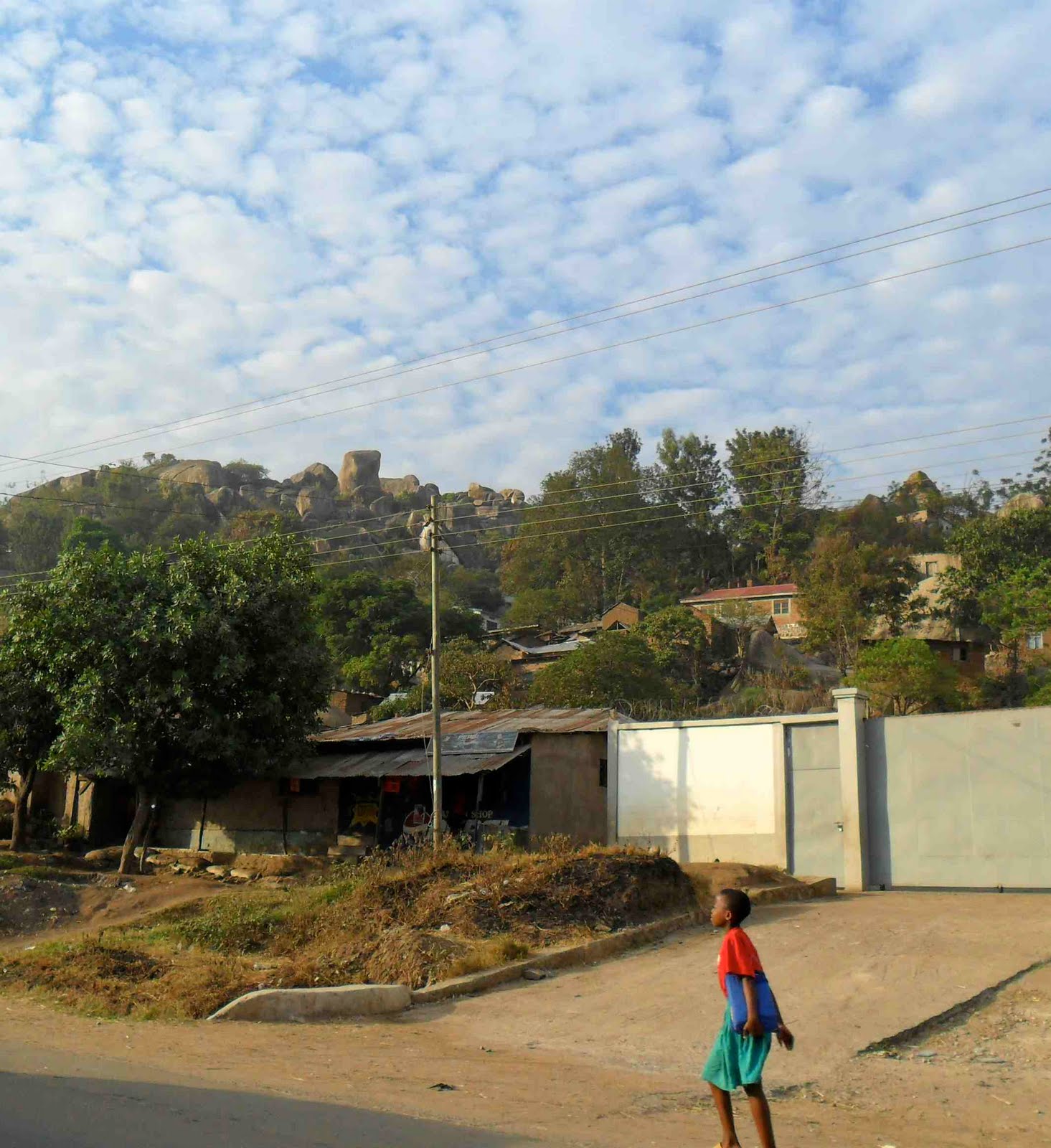
Mwanza is not called Rock-city without reason.  It’s as if the city is built on a pile of boulders.  There are boulders piled on boulders, there are balancing rocks and obelisks.  The houses are built around and on top of the rocks.

Mwanza is the second biggest city in Tanzania.  It has a large fishing fleet and a big, new fish market paid for by the Japanese.  It is an easy city to get around and is much more pleasant than Dar es Salaam.


Steve had booked us a room at the fanciest hotel in Mwanza – the Tilapia Hotel.  It was very pleasant!  We made the most of the free wireless internet and downloaded a heap of podcasts for Steve’s iPod.  I had planned to swim in the pool but it was too public – overlooked by the bar – and I didn’t want people shouting ‘hippo’!  

There were some fabulous brass sculptures of the Big Five as well as some wonderful African art and craft and a collection of wall plates from places as diverse as Westminster, Tokyo and Florida.  (I could have contributed one with a picture of Gray Street if I’d known!)
 
It has been a very pleasant break!  The only down side is that Michelle, the other Australian volunteer, and her family decided to go home to Australia this weekend, because of family health issues, and we have missed helping them pack up.  We will miss them very much, not just professionally where Michelle’s quiet, reflective approach has balanced my more impetuous attitude, but socially too at the Bukoba Club where we meet for drinks on Friday evening.


Keep reading and commenting people!  Love Jenny

Friday, 3 September 2010

September 3rd

(This one is probably only for people with an interest in education!)

Today I am working from home – Mr Josiah suggested that would be best!  The office has become increasingly frantic over the week as the District Education officers prepare for the Standard VII National Examinations and the ‘frantic-ness’ will reach a peak today and over the next 4 days.

The Standard VII exams are an important event! They mark the end of a pupil’s primary school education.  They determine which pupils are allowed to proceed to secondary education, and in which school they will be enrolled.  The Standard VII pupils do not return to school (unless they are at a private school in which case they will be assumed to have passed and will do preparing for Form 1 courses up until Christmas!) until they begin secondary school next January.  Those students who do not pass may repeat Standard VII or start full-time employment.  [Students are sometimes encouraged to fail if their families could not afford to send them to secondary school.]

There are 5 examinations – kiSwahili, english, social studies, mathematics and science – each 1½ or 2 hours, held over 2 days.  The exams cover the syllabus from Standard V to VII.  Each examination has 50 questions.  All but the maths are mostly multiple choice or “fill in the blank” for ease of marking.  The mathematics paper requires just answers on the answer sheet – no marks for working out.  At least this is what we assume!  Getting copies of past exams has proved impossible and I have seen only the ‘mock’ exams prepared by the region and by World Vision.

To pass Standard VII a pupil must achieve a total score across all 5 exams of 100 out of 250.  Scores for individual exams are not important, indeed a pupil could ‘fail’ all exams and still ‘pass’ Standard VII.  At school reviews we were told that some children give up on maths and concentrate on the other four subjects as they feel they will get enough marks to pass – the results we have seen show this could be true with most schools achieving average scores of  around 12 and the best only averaging 20 out of 50. (Compared to a best average of 40/50 for English)

Teachers, Head Teachers, Ward Education Coordinators (WECs) and regions are judged on how well their students do so there is a lot of pressure.  (Maybe Julia could provide aid money to establish a Tanzanian My Schools website if she gets to be PM.)  It is last year’s results that Michelle and I have been collating and analysing to see where we need to put our effort.  The region has itself made mathematics education a priority.


The exams for pupils in Bukoba district will arrive this weekend and be counted out and distributed to each Ward Education Coordinator on Sunday.  On Monday the teachers who have been appointed invigilators will be picked up by bus from their home school and taken to another school to invigilate. ( A sort of magical mystery tour scenario as they don’t know where they are going until they get there.) 

The exams are taken very seriously and the examination is conducted under strict security.  There are forms for each pupil that include photo ID to ensure there is no cheating.  The children are seated one pupil to a desk instead of the usual 3 or 4.

Only the Standard VII children will be at school on Monday and Tuesday – all other students are on mid-term break for the week.  This is handy as ‘End of Ramadan’ holiday and celebrations will be happening on Thursday and Friday.

Michelle and I have prepared a survey to go to schools after the exams are finished to get specific information about professional development needs – our work on running seminars can then begin.

 (Steve and I are having a break too – 4 days at Speke Bay – but more on that next post.)

Sunday, 29 August 2010

A message from the (domestic) front …

It has taken time but we are getting the domestic side of life organised.  Steve is now the chief cook and bottle washer and I am trying hard to leave it to him.  But you know how hard it is to break old habits!

For those of you who wanted to see more of our house:

This is the living room.  We have a three piece lounge suite and a bookshelf that is hidden under the cloth (on the right) to keep dust out. We watch episodes of “West Wing” and “House” on Steve’s laptop in the living room and we eat our meals at the little table.  It is a very pleasant room.  The front verandah is off the living room but it is too dusty to sit out there.  It might be a good spot to sit when the rain starts in earnest.


 The main bedroom is quite big.  Our bed is smaller than a double bed so it’s lucky we’ve both lost some weight.  It is quite comfortable and we are now used to sleeping under the mosquito net.  The wardrobe is tiny and I have it for my clothes.  Steve’s are on a sofa in one of the spare rooms.  We have two spare bedrooms both with small double beds.  We are waiting for the landlord to have the mattresses recovered so they will be useable by visitors.  Our little refrigerator is in one of the bedrooms as there is only one power point in the kitchen and we need it for the stove, kettle and toaster.

 This is the kitchen.  The sink drain does work but we still wash up in a basin as we can’t get a plug to fit the sink! The water filter works well.  We are limited in what we can cook by the two hotplates – that let Steve off making me a birthday cake this year.


And the pièce de resistance – the bathroom!  It has two major pluses -
it is inside and it functions.  So far cold showers have not been a problem, the weather is quite warm and the water is not icy.  The squeegee helps the water run in the right direction to get to the drain after showering.  (I wish someone would teach plumbers about gravity!) The least said about the squat toilet the better!  We mightn’t like it but we are managing.


The backyard will one day have another house in it.  The foundations are there as well as piles of bricks and sand.  There are many plants, including vegetables, growing in each of the ‘cells’ of the foundations.  We have been eating home grown eggplant and tomatoes.  We should also get potatoes and sweet potatoes later in the year.  I have sown some watermelon seeds so maybe they will grow when the rain comes.

 
Steve spends a major part of each day in the backyard.  Already 80 bird species have come to visit.  New ones appear regularly so the novelty has not yet worn off.  Maybe when it does he’ll get more into the cooking (or maybe not!)  A 2.5 m brick wall surrounds our yard giving us some privacy. 
We have close neighbours only on one side – a group of families, two shops, two hair salons (men’s and ladies’) and a video viewing saloon which I think also hosts small political rallies for the Centre Unity Party.  The shops sell rice, sugar and maize flour by the kilo but also wheat flour by the kilo and dried yeast by the spoonful so I have been able to make flat bread.  The ladies who run the shops were sceptical when I said I planned to make chapatti with the flour and yeast.  I gave them some when it was cooked and they were very impressed though said I should have used salt!  We converse in a mixture of English, kiSwahili and kiHaya.  The little children who live next door like me to use kiHaya.  They give me gifts of stones and pieces of wood so I’ll say “kisinge” to them.  There is also a carpenter next door who made me some wooden cubes for dice.
On the corner of our road and the main road, about 100 metres from us, there are some small shops that sell a limited variety of fruit and vegetables and also soda (Coke and Fanta).  Today one was also selling meat.  A side of what looked like goat was hanging up out in the open air and the sales lady would have cut a bit off for us if we’d wanted it.
In the other direction, about a kilometre away, there is a small settlement with about 12 shops selling most of the things we might need though again the fruit and vegetables are limited to what the shop keepers have grown themselves.  The market in town has much greater variety but at our local shops we don’t pay the mzungu surcharge.
So far the only meat we have bought to cook is frozen mince steak from the Fido Dido Grocery where we also get other western items – peanut butter, jam, pasta, instant coffee and tea bags.  The meat has been very nice in pasta sauces.  Buying a small fridge has made the food buying/cooking/storing process much easier.
So far the change to living here has been surprisingly easy.  We feel safe and welcome (or relaxed and comfortable!) in our home and work communities.  I am sure we will have some difficult times over the next 10 months (the time is slipping away so quickly!) but so far we are very content.

Wednesday, 25 August 2010

School with a million dollar view.


The schools we visited today are high above Kemondo Bay with magnificent views of Lake Victoria and the little town of Kemondo with its sandy bay and wharf where the Bukoba – Mwanza ferry calls in to pick up bananas and passengers.  Views that are not spoiled by those unsightly power or telephone lines!  These schools are in Katerero ward and are among the most disadvantaged we’ve seen to date.


At our meetings with the teachers we heard the same litany of reasons for poor academic performance; each reason enough on its own and each compounding the others.

The parents are poor and uneducated – they often do not value education.  The children are kept home to work on the farm or mind the little ones so the parents can go to the markets to sell their bananas and fish.  Uniforms, pens and books cost money the parents can’t spare.  The child often has to work to pay for these things.  Homework is not done as there is no kerosene to provide light at night.  Passing the Standard VII means the expense of sending the child to secondary school – again costing money for uniforms and books – so is actively discouraged.

Girls especially suffer as they have the lion’s share of work to do at home and you can work out for yourself the problems of puberty in the Third World.  Boys often truant if there is work going in the local quarry or brick kiln but they at least are paid!

Preschool classes are available to children aged 5 and 6 but these are poorly attended especially when there is a church run preschool available where the children get a religious education more prized by the parents and often in the local vernacular rather than KiSwahili.  Children then start at Government school at the compulsory age of 7 with no KiSwahili let alone English.

These rural schools are hard to staff.  There is no close accommodation for teachers, and teachers usually have no transport of their own.  In the 16 school visits we have done we have met one teacher who has her own car!  Some teacher houses are being used for offices and even classrooms, where the schools are overcrowded, though this is not always practical if there are not enough teachers to put one in front of each class anyway!  One school of 400 children had only two ‘safe’ classrooms.  The rest were badly built in 1930 and have had no renovation since – the floors are broken cement and the roofs leak in the wet, there are only small windows so there is limited light and ventilation.  Some were originally built as offices and are far too small for the number of children and desks.


Teachers are overworked and undervalued.  A teacher is expected to check each child’s exercise book after every lesson and there can be over 70 children in the class.  Inspectors come to the school to check this is being done.  Morale did not improve when the local District Commissioner had some teachers beaten by the police for what he considered to be their underperformance!  The government would like teachers to use more participatory methods but there is no money for teaching aids.  Even paper is rationed and aids must be made from ‘found materials’ – cardboard boxes, washing lines, wood off-cuts.  One teacher had made a ‘clock’ from a polystyrene box.  It had hands cut from a piece of plastic and they were held in place with a nail.  Such ingenuity and imagination!  I am collecting such ideas to share in other schools.

In 2005 new curricula were introduced.  Teachers received no professional development about these changes.  They consistently tell us they need refresher courses to understand the changes, and new ways to teach to keep the children interested.

Despite all this children are learning to read, write and count (here called the 3Ks – kusoma, kuandika na kuhesabu); some are passing the Standard VII and will go on to secondary school.  The best will get a place at a secondary boarding school, often several days’ bus travel from their home, and will get a good education allowing them to escape poverty.  Some may return as teachers to keep working at giving all the children of Tanzania the universal primary education promised in the Millennium Development Goals.


There is so much that I can have no influence over, but I will certainly be striving to support these wonderful, enthusiastic and optimistic teachers as they try to teach mathematics in conditions that my colleagues at Baimbridge would struggle to imagine let alone teach under.